Horse Terms Glossary
New to horses? This comprehensive glossary will help you understand the terminology used in our lessons and around the barn.
What horse terms should I know for riding lessons?
Essential horse terms for beginners include: tack (riding equipment like saddle and bridle), gait (walk, trot, canter, gallop), hand (4 inches, for measuring horse height), aids (signals to communicate with the horse), and grooming (cleaning and caring for the horse's coat). Understanding these terms helps you communicate effectively during riding lessons.
Our comprehensive glossary below covers 50+ terms used in horseback riding, from anatomy (withers, fetlock, poll) to equipment (bit, reins, stirrups) to gaits and riding techniques. Perfect for parents and students enrolled in our riding lessons or summer camp.
Visual Guides
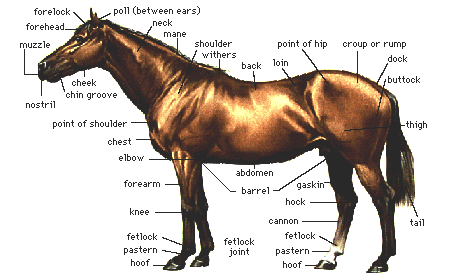
Horse Anatomy
Face Markings
A
Aids
The signals a rider uses to communicate with the horse, including leg pressure, rein contact, seat position, and voice.
Arena
An enclosed area for riding, training, and exercising horses. Can be indoor or outdoor.
B
Barrel
The middle section of a horse's body, between the shoulder and hindquarters.
Bit
The metal piece of a bridle that goes in the horse's mouth, used for steering and stopping.
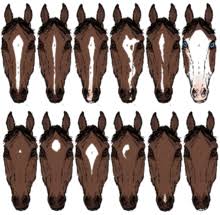
Blaze
A wide white marking running down the center of a horse's face.
Bridle
The headgear used to control a horse, including the headstall, bit, and reins.
C
Cannon
The lower leg bone between the knee (or hock) and the fetlock.
Canter
A three-beat gait faster than a trot but slower than a gallop.
Chestnut
A reddish-brown coat color. Also refers to the small horny growth on the inside of a horse's legs.
Cinch
The strap that goes under the horse's belly to hold the Western saddle in place (called a girth in English riding).
Cross-ties
Two ropes clipped to either side of a halter to hold a horse safely in the aisle for grooming and tacking up.
Curry Comb
A rubber or plastic comb used in circular motions to lift dirt and loose hair to the surface of the coat before brushing.
Colt
A young male horse under four years of age.
Crop
A short whip used by riders to encourage forward movement.
Croup
The top of the hindquarters, from the hip to the tail.
D
Diagonal
The pair of legs a horse moves together at the trot. A posting rider rises and sits in time with one diagonal pair to help the horse stay balanced.
Dressage
A discipline focused on precise movements and harmony between horse and rider.
E
Equitation
The art and practice of horseback riding, focusing on the rider's form and position.
F
Farrier
A specialist who trims and shoes horses' hooves.
Fetlock
The joint between the cannon bone and the pastern, often called the 'ankle'.
Filly
A young female horse under four years of age.
Foal
A baby horse of either sex, typically under one year of age.
Forelock
The portion of the mane that falls between the ears and onto the forehead.
G
Ground Manners
How well a horse behaves when handled from the ground — standing quietly, leading politely, and respecting the handler's space.
Groundwork
Training and handling done from the ground rather than the saddle, such as leading, standing and lunging.
Gait
The pattern of leg movements. The four natural gaits are walk, trot, canter, and gallop.
Gallop
The fastest four-beat gait of a horse.
Gelding
A castrated male horse.
Girth
The strap that goes under the horse's belly to hold the English saddle in place.
Grooming
The process of cleaning and caring for a horse's coat, mane, tail, and hooves.
H
Halter
A headpiece used for leading or tying a horse. Does not have a bit.
Hand
A unit of measurement for horse height. One hand equals 4 inches.
Hock
The joint in the hind leg corresponding to the human ankle.
Hoof
The hard covering on the foot of a horse, similar to a human toenail.
Hoof Pick
A small hooked tool used, with instructor guidance, to clear dirt and stones from the underside of the hoof.
Horsemanship
The whole skill of working with horses — safe handling, horse care, grooming, tack and riding — of which riding is one part.
L
Latigo
The strap used to fasten a Western cinch to the saddle.
Lead
At the canter, the foreleg that reaches further forward. Riders are usually asked for the inside lead when circling in that direction.
Lead Rope
A rope attached to the halter used to lead or tie a horse.
Lunge/Longe
To exercise a horse in a circle on a long line, controlled from the ground.
M
Mane
The long hair growing from the top of a horse's neck.
Mare
An adult female horse, typically four years or older.
Mounting
The act of getting on a horse.
Muzzle
The area of the horse's head including the nose, nostrils, and lips.
N
Near Side
The left side of the horse. Horses are traditionally mounted from this side.
O
Off Side
The right side of the horse.
P
Palomino
A golden coat color with a white or cream mane and tail.
Pastern
The area between the fetlock and the hoof.
Poll
The top of the horse's head, between the ears.
Posting
Rising and sitting in rhythm with the trot to make it more comfortable.
R
Reins
The straps attached to the bit, held by the rider to steer and control the horse.
S
Saddle
The seat for a rider, placed on the horse's back.
Saddle Pad
A cushioned pad placed under the saddle to protect the horse's back.
Showmanship
A class judged on how well a handler presents and moves a horse from the ground, including grooming, turnout and precision.
Snip
A small white marking on the muzzle or between the nostrils.
Sock
White marking on the leg extending from the hoof to the fetlock or higher.
Stallion
An adult male horse that has not been castrated.
Star
A white marking on the forehead.
Stirrup Leather
The adjustable strap that attaches an English stirrup to the saddle and sets its length.
Stirrups
The foot supports hanging from the saddle.
T
Tack
Equipment used for riding, including saddle, bridle, and other gear.
Two-Point
A position, also called half-seat, in which the rider lifts slightly out of the saddle with weight in the heels and legs.
Trot
A two-beat diagonal gait, faster than a walk but slower than a canter.
W
Walk
The slowest four-beat gait of a horse.
Whinny
A high-pitched vocalization made by horses.
Withers
The highest point of the back, at the base of the neck, used to measure a horse's height.